
FANATIC
a scherzo for violin / cello / horn & piano
Work Details
2010, rev. 2025
ca. 8–10 minutes
Listen
Program Notes
Fanatic — for Violin and Piano
Fanatic was commissioned for violinist Alicia Choi in 2010. I wrote the piece as the Tea Party movement gathered force across the United States, including in my native Kentucky. Its rapid growth stirred in me a deep anxiety about increasingly radical forms of tribal politics and the ease with which anger, fear, and grievance can be transformed into collective identity.
The music takes the form of a brutal scherzo: raw, abrasive, and deliberately rough around the edges. It draws on the primitivist energy of Stravinsky’s Le Sacre du printemps, while incorporating a faint trace of bluegrass in reference to western Kentucky, where I grew up. Owensboro is now home to the Bluegrass Music Hall of Fame and Museum, and the surrounding region gave rise to Bill Monroe, whose musical language remains inseparable from the cultural identity of that part of the state.
Fanatic does not attempt to represent a particular political figure or event. It responds instead to a recurring political condition: the transformation of fear into certainty, certainty into belonging, and belonging into hostility. The violin and piano pursue one another with mounting aggression, locked in a volatile exchange that rarely allows either instrument to retreat.
—SC
Fanatic — for Horn and Piano
Fanatic was originally composed for violin and piano in 2010, during the rise of the Tea Party movement in the United States. Watching that movement take hold, particularly in my native Kentucky, stirred in me a growing anxiety about political radicalization, tribal allegiance, and the appeal of absolute certainty in moments of social unrest.
The piece is a brutal scherzo, driven by repetition, collision, and physical force. Its language draws on the primitivist intensity of Stravinsky’s Le Sacre du printemps, with a subtle trace of bluegrass connecting the music to western Kentucky. That reference is not intended as parody. It emerges from affection for the region and from an awareness that cultural identity can be a source of both community and division.
In adapting the piece for horn and piano, the character of the music changed. The violin’s sharpness and speed became something heavier and more vocal: breath under pressure, calls turned into warnings, and gestures that move between defiance and exhaustion. The horn’s associations with distance, alarm, and collective ritual bring a different psychological weight to the work.
Fanatic is not offered as a solution or an argument. It is an expression of alarm—a response to the recurring tendency of political movements to convert fear and resentment into identity, certainty, and force.
—SC
Fanatic — for Cello and Piano
Fanatic was originally composed for violin and piano in 2010, as the Tea Party movement swept across the United States, including my native Kentucky. I wrote the piece out of anxiety about an increasingly radical and tribal political culture: one in which fear, grievance, and absolute certainty could be used to bind people together while directing their anger outward.
The music is a brutal scherzo—raw, physical, and intentionally rough. It draws on the primitivist energy of Stravinsky’s Le Sacre du printemps and contains a small trace of bluegrass in reference to western Kentucky. Owensboro, my hometown, is now home to the Bluegrass Music Hall of Fame and Museum, while the surrounding region gave rise to Bill Monroe and the musical tradition most closely associated with his name.
In 2025, I returned to the piece and revised it for cello and piano as many of the concerns that prompted the original work surfaced yet again. I recognize my own political biases, but the movements emerging from the political right continue to provoke in me a particular alarm. The music felt no less urgent than it had fifteen years earlier. In the context of what I witnessed in downtown Los Angeles in June 2025, it felt more immediate than at any previous point in my life.
I do not presume that a piece of music can change political convictions. Fanatic instead attempts to give form to a pattern I find deeply troubling: the transformation of fear into anger, anger into belonging, and belonging into aggression. In the cello version, the music acquires greater weight and darkness. Its gestures remain fast and volatile, but the instrument’s depth and physical resistance make the struggle feel more exposed.
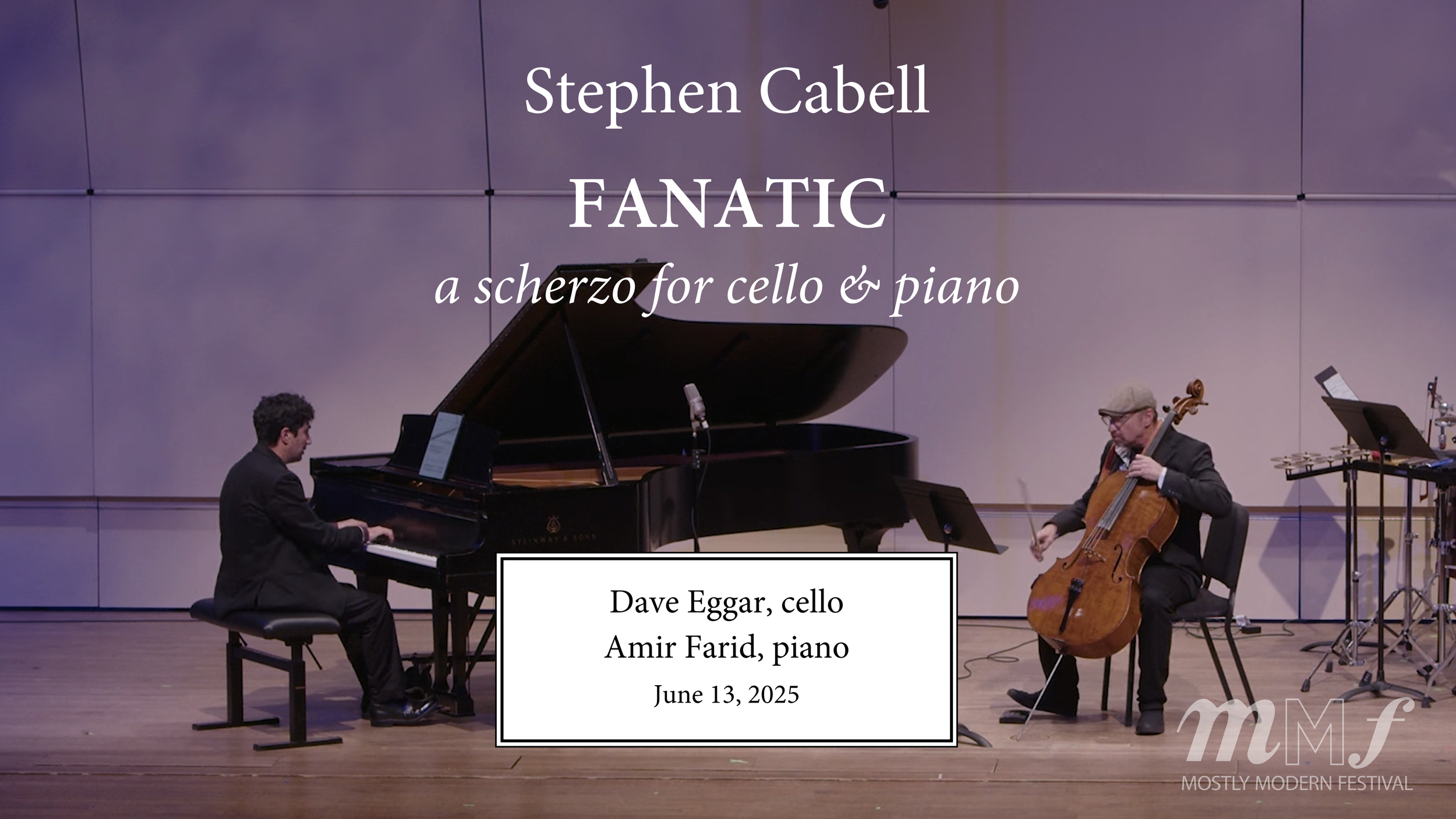
This version is dedicated to Dave Eggar and Amir Farid, who gave its premiere in June 2025 at the Mostly Modern Festival.
—SC